
Some of our clients enjoy keeping up with how markets have been behaving, while others prefer to focus on their long‑term plans rather than short‑term movements. Whichever camp you fall into, this quarterly commentary provides a snapshot of what has been happening across global markets and the factors influencing investment performance.
It’s worth remembering that no single quarter tells the whole story — long‑term goals, diversification, and staying invested remain far more important than any short‑term market changes. But for those who like to stay informed, the following highlights summarise the main themes from the past three months.
This commentary is aimed at readers with a foundational to intermediate knowledge of investments — those familiar with concepts such as equities, bonds, and diversification, though anyone with an interest in markets may find it useful.
Key Moments of the Year
- Despite a sharp sell-off in April, global markets performed well with the UK and Emerging Markets outperforming particularly
- Gold and Silver hit record levels
- The US dollar weakened against other major currencies
- Despite concerns around a bubble, Artificial Intelligence (AI) stocks continued to perform well from an earnings and price perspective
- Bonds performed well with investment- grade corporate bonds seeing strong inflows
- With areas such as Banks and Commodities performing well, Sustainable investments lagged
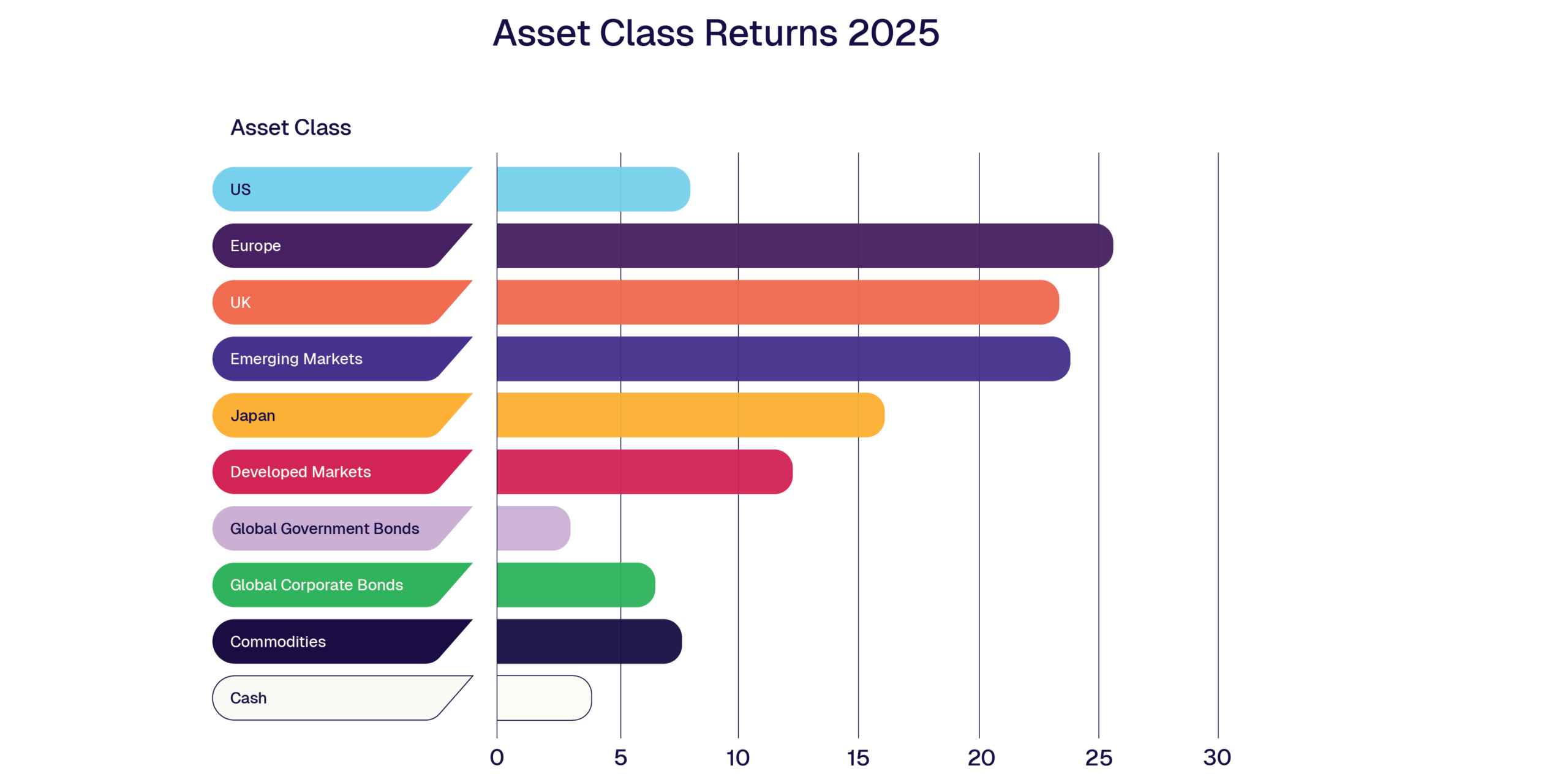
Source: FE Analytics. US: S&P500, Europe: MSCI Europe ex. UK, UK: FTSE 350, Emerging Markets: MSCI Emerging Markets, Japan: TOPIX, Developed Markets: MSCI World, Global Government Bonds: Bloomberg Global Treasury, Global Corporate Bonds: Bloomberg Global Aggregate – Corporate, Commodities: Bloomberg commodities index, Cash: BoE Sterling overnight index average. All Indices are hedged back to pounds sterling. These figures refer to the past and that past performance is not a reliable indicator of future results.
Equities
Artificial intelligence remained the central theme in US markets throughout 2025. However, only two of the ‘Magnificent Seven’ managed to outperform the S&P 500. While AI continues to dominate investor sentiment, it is still unclear who the long-term
winners and losers will be. Concerns about an AI-driven bubble persisted as valuations climbed, yet earnings have broadly held up, and current price-to-earnings ratios are still well below those seen during the Dotcom era.
Tariffs applied to US imports created headwinds for American companies, many of which have absorbed higher input costs rather than passing them on to consumers. This helped avoid a renewed spike in inflation but weighed on corporate margins. Over time, it is likely that more of these costs will be passed through to consumers, which may support company profits but prove less favourable for inflation and household spending.
Although attention generally centres on the US given its dominance in global indices, market leadership in 2025 came from outside America. Emerging markets delivered strong equity returns, supported by several factors. A weaker US dollar made emerging market assets more attractive, particularly as governments and companies in these regions often borrow in dollars, reducing the effective cost of servicing debt. Valuations were also compelling at the start of the year, drawing capital towards more attractively priced opportunities. In addition, Chinese advancements in AI supported Asian technology shares, while ongoing diversification of trade relationships helped offset the impact of tariffs on Chinese exports.
Japan also performed strongly. The Bank of Japan’s shift away from ultra-loose monetary policy towards gradual rate increases was interpreted as confidence in more durable economic growth. Markets further responded positively to the election of Prime Minister Takaichi and expectations of increased government investment.
Despite subdued sentiment around the UK economic outlook, the domestic market significantly outperformed in 2025. This was driven predominantly by the FTSE 100, which has substantial exposure to Financials and Energy, and whose constituents generate most of their revenues overseas leaving them relatively insulated from domestic challenges. In contrast, smaller UK-focused companies continued to lag the broader market.
Bonds
Fixed income provided solid returns during 2025. Volatility was concentrated in the first half of the year, as macroeconomic uncertainty and tariff announcements unsettled markets. Conditions stabilised in the latter half, with inflation trends improving and both the Bank of England and the Federal Reserve able to continue easing monetary policy.
Emerging market debt and high-yield bonds were among the strongest performers. However, investors did not see a meaningful premium for taking on higher risk, which led many to favour short-dated investment-grade corporate bonds—offering attractive yields with lower volatility.
Outlook
Geopolitical tensions and the gradual unwinding of globalisation are likely to persist in the near term. Their impact on markets is hard to predict, and these dynamics may create more uneven performance across sectors and regions.
Both the Bank of England and the US Federal Reserve are likely to continue cutting interest rates modestly through 2026, which could provide a tailwind for equities and bonds. However, policymakers will be alert to renewed inflation pressures, particularly wage growth, which could limit the pace of easing.
Although most asset classes delivered positive results in 2025, we remain cautious on growth prospects for 2026. Last year demonstrated that broad diversification was the most effective strategy, and we expect this theme to remain relevant.
We know that market updates aren’t for everyone, and that’s perfectly fine. The purpose of this commentary is simply to give you a clearer understanding of some of the factors that professional investment managers consider when building and maintaining portfolios.
Nothing here is intended to guide personal investment decisions. Instead, these developments are monitored and interpreted by the investment managers behind your funds or model portfolios, who make changes where appropriate as part of a structured investment process.
If you’d like to understand how these themes relate to your longer‑term plan — or if you simply have questions — your Financial Planner is always ready to help.
Important Information:
This commentary is for general information only and does not constitute personal financial advice. You should seek advice tailored to your individual circumstances before making any investment decisions.
Past performance is not a reliable indicator of future results. Investments can go down as well as up. You may get back less than you invested.
Market conditions can change rapidly. The views expressed are based on current market conditions and may change without notice. Any estimates, forward-looking statements or forecasts do not represent a guarantee of future performance. The information is not intended to be complete or exhaustive and no representations or warranties, either express or implied, are made regarding the accuracy or completeness of the information contained herein. Reliance upon information in this material is at the sole discretion of the reader.
References to individual companies are for illustrative purposes only and do not constitute a recommendation to buy or sell.
Timothy James & Partners Limited is registered in England & Wales as a Limited Company, No. 03138148. Authorised and regulated by the Financial Conduct Authority, No. 179854.
Registered office address: Shell Mex House, 3rd Floor, NE Eighty Strand London WC2R ODT. Telephone: 020 7436 6446.


 Share
Share